
Perplexity introduced a new Multiagent mode within its Computer service. A single task can now be handled by a team of up to 16 auxiliary AI agents running on leading frontier language models. In the standard configuration, Claude Fable 5.2 acts as the lead planner, while auxiliary models include Claude Opus 5.5, GPT-6.1 Sol, and Gemini 4 Carbon. Agents can explore problems in parallel, pass intermediate findings directly to one another, verify peers' conclusions, and collaborate on shared files.
The feature is available to Perplexity Max subscribers via the Computer web interface as a new effort level above Ultra. For the user, the entire workflow feels like a single conversation with the lead agent, who orchestrates the team and compiles the final deliverable.
Why Combine Different Models
Modern flagship neural networks excel in different areas. One model might handle deep document analysis and long context windows more effectively, another shines at writing and testing code, while a third is adept at cross-referencing sources and spotting inconsistencies. Relying on a single powerful model to execute every stage of a complex assignment consecutively leaves it vulnerable to its own biases, context window constraints, and runtime limits.
Multiagent relies on division of labor. The lead agent breaks the assignment into subtasks, delegates parts to specialized models, and may execute other parts directly. For a comprehensive financial report, this could mean analyzing revenue streams, expenses, commercial contracts, and alternative scenarios simultaneously. Agents then compare inputs and notify each other about updates. The final synthesis is performed by the lead agent.
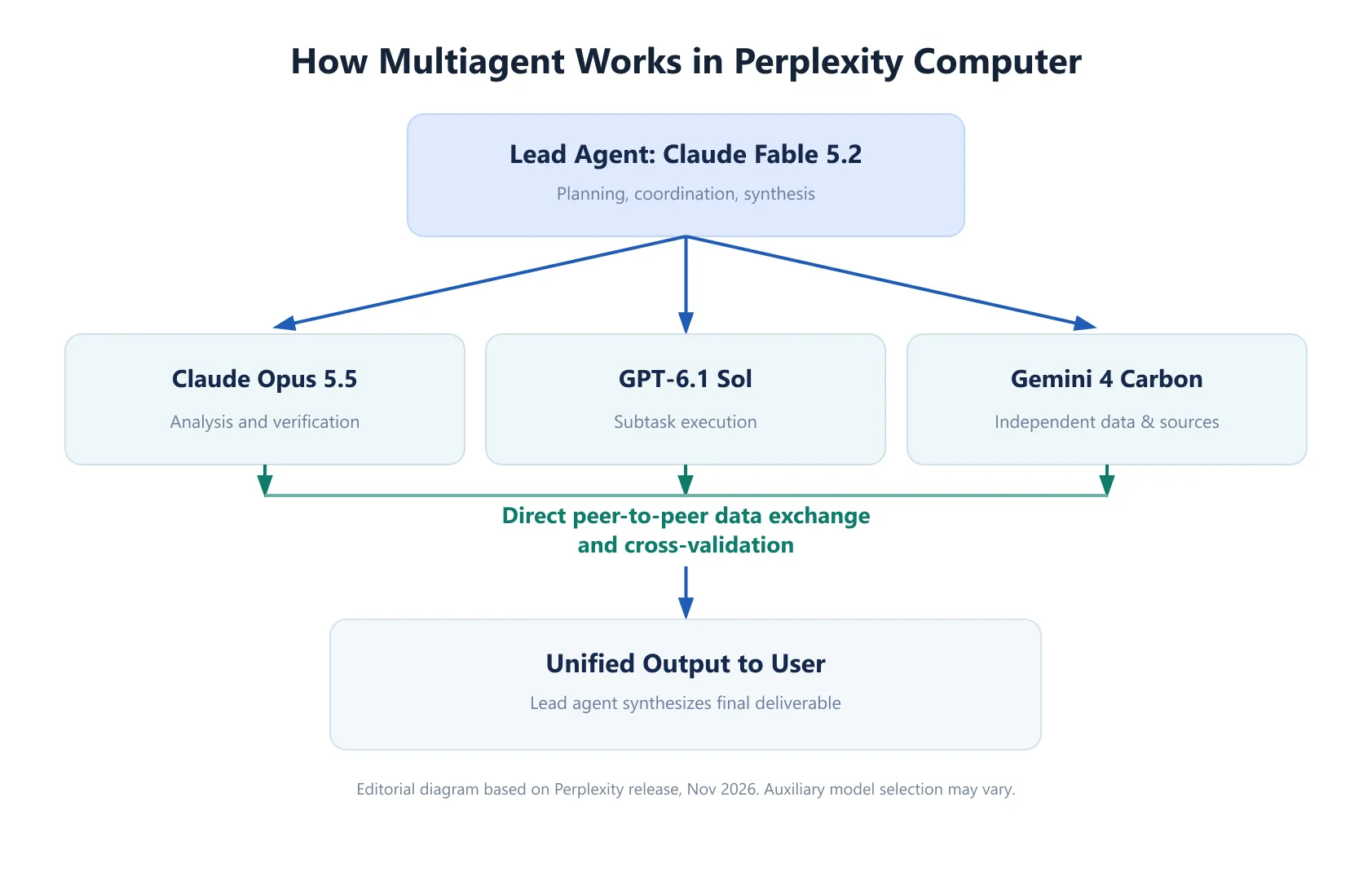
Illustration 1. Simplified diagram of the standard Perplexity Multiagent configuration. Team composition and active agent count depend on the specific task. Source: Perplexity.
It is crucial to distinguish between the number of models and the number of agents. "Up to 16 agents" does not mean 16 distinct LLMs. Multiple agent instances can run on the same underlying model, and simpler tasks do not require the system to spin up the maximum team size.
How Inter-Agent Coordination Works
According to Perplexity's official release, Claude Fable 5.2 serves as the team lead. It decomposes the prompt, selects suitable executors, maintains global context, and aggregates final outputs. By default, auxiliary agents run on Opus 5.5, GPT-6.1 Sol, and Gemini 4 Carbon. Users can request alternative models; Perplexity notes that Fable 5.2 and GPT-6 Astra are also available as additional options.
The core architectural departure from traditional hierarchical delegation is horizontal communication. An agent reviewing commercial contracts can pass an identified revenue caveat directly to the financial modeling agent. The financial agent recalculates its projections and relays the updated figures to a third agent drafting the summary. Information does not have to route through the coordinator at every step.
Perplexity also notes that agents coordinate edits in shared files. The lead agent remains the single point of contact: users do not need to prompt each auxiliary model individually. When a user provides feedback or alters parameters, updates are propagated specifically to the affected agents. Canceling the task stops the entire team simultaneously.
Multiagent, Ultra, and Model Council: Key Differences
Computer already offers Ultra and Model Council modes, but each serves a distinct purpose.
| Mode | Task Distribution | Best Use Cases |
|---|---|---|
| Ultra | Lead agent delegates subtasks, executors report strictly to the lead | Research tracks with distinct, independent sub-questions |
| Multiagent | Auxiliary agents share findings directly, debate, and co-edit outputs | Projects with interdependent subtasks requiring mutual alignment |
| Model Council | Multiple models independently answer the same prompt; answers are compared | Decisions where diverse, unbiased viewpoints are essential |
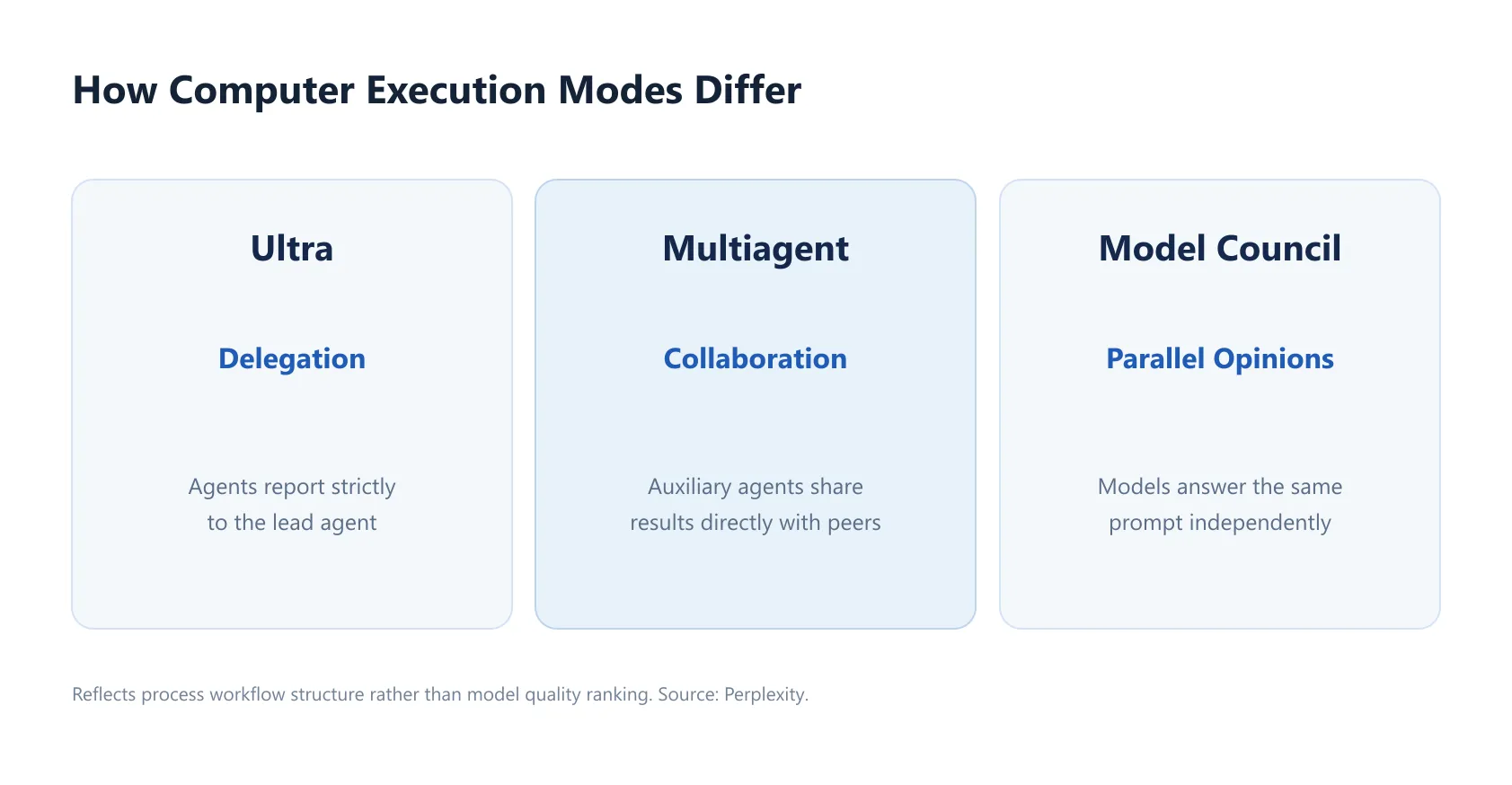
Illustration 2. Three ways to structure AI workflows. This represents procedural differences rather than raw model rankings.
When the goal is obtaining independent perspectives on a single hypothesis, Model Council is often the superior methodological choice. When producing an exhaustive report with tightly coupled sections, Multiagent offers deeper alignment capabilities. Ultra remains the pragmatic option for tasks where top-down coordination suffices.
Target Scenarios Highlighted by Perplexity
The release highlights five primary application scenarios. The first is financial modeling, where different agents construct scenario forecasts, challenge underlying assumptions, and evaluate the ripple effects of revenue or cost changes. The second is annual report auditing, checking figures across balance sheets, footnotes, and management commentary.
The third scenario is deep investigative research into disputed topics: team members gather competing explanations and evaluate which claims are backed by solid evidence. The fourth is M&A due diligence, analyzing large document repositories where legal disclosures can alter earlier valuation models. The fifth is tax planning, preparing structured options and targeted questions for professional advisors.
The financial and analytical scenarios are particularly notable: tasks with disparate data sources and interdependent calculations frequently break down when assumptions change in one section but remain outdated elsewhere. Direct inter-agent communication directly targets this risk.
Do 16 Agents Deliver Better Answers?
In theory, cross-validation can catch hallucinations or errors missed by a single system. However, multi-agent architectures introduce distinct failure modes. Agents can amplify shared misconceptions, cite one another rather than primary sources, perpetuate flawed premises, or spend excessive computational cycles debating trivialities. If the lead agent frames the initial problem incorrectly, adding more helpers will not rectify the root mistake.
Another critical consideration is cost. Running parallel exploratory paths, redundant document reads, and frequent inter-agent messaging consumes significant token volumes and compute. Multiagent will not inherently reduce operational expenses. The true measure of value is the total cost per validated output, factoring in review time, latency, and human intervention. Perplexity has not published comprehensive benchmark metrics demonstrating that 16 agents deliver a specific percentage increase in accuracy over a single model.
There is also a risk of cognitive convergence. If agents exchange intermediate findings too early, an error made by one participant can bias the rest. In such scenarios, Model Council's strict isolation is methodologically cleaner. Multiagent shines specifically where complex, collaborative refinement of interdependent work is necessary.
Industry Context: The Shift to Model Orchestration
Perplexity is developing Computer as an execution environment where AI handles long-horizon tasks across file systems, search, code execution, and external integrations. This new mode reflects a broader industry shift: consumer and enterprise interfaces increasingly abstract away individual LLM selection, dynamically matching models and workflows to subtasks. Similar orchestrations power modern agentic coding and research frameworks.
Consequently, competitive advantage is moving from isolated LLM benchmark scores to the robustness of the end-to-end agentic workflow. Tool reliability, inter-agent coordination, data grounding, source verification, and graceful error recovery now matter just as much as raw parameter count.
How to Get Started and What to Evaluate
To enable the feature, Perplexity Max subscribers can launch Computer in their browser and choose Multiagent under effort level settings. The interface displays active agents and their assigned models in real time. For initial testing, select a workflow with tightly connected components: for example, a financial statement review combining contract analysis, scenario modeling, and an integrated synthesis.
Focus evaluation not on the total agent count shown on screen, but on quantitative accuracy, citation integrity, cross-section coherence, and the cost efficiency of the completed deliverable. Those metrics will reveal whether multi-model orchestration delivers tangible practical utility.