
A new benchmark evaluated programming AI agents inside a virtual engineering organization. The leading models successfully passed around 63% of individual requirement checks, but fully completed under 8% of assignments. The research sheds light on why impressive coding test scores do not yet translate to independent project delivery.
AI programmers have achieved impressive results on popular benchmarks. Modern coding agents can detect bugs, modify repositories, and run tests. Yet in a real-world software team, development begins long before code is written: engineers must clarify ambiguous requirements, align architectural decisions across colleagues, navigate fragmented documentation, and verify whether the task is genuinely complete.
The researchers behind SWE-CoWork reproduced these realistic conditions. They evaluated 11 models within a simulated engineering organization, uncovering a massive gap between partially implemented functionality and complete task delivery.
How the Virtual Software Company Works
The benchmark comprises 101 tasks across 101 real-world repositories, covering 11 programming languages and 12 distinct software domains. In each scenario, the agent operates inside an organization populated by 26 simulated colleagues with distinct roles and restricted domain knowledge. Rather than receiving a clean specification, the agent must autonomously discover what changes need to be made.
The initial assignment prompt is deliberately brief. Missing details may reside in discussion threads, internal documentation, issue tracker cards, or the heads of specific team members. Sources occasionally contradict one another. The agent must proactively ask questions, reconcile conflicting requirements, and revisit ongoing work.
A median task spans approximately 2,955 lines of production code, 60 files, and 32 executable test cases. This presents a vastly higher level of complexity than a standard benchmark task with an isolated bug description. However, because the colleagues are simulated, the experiment cannot be directly equated to collaborating with a living human team.
Results: Tests Pass, but Projects Remain Incomplete
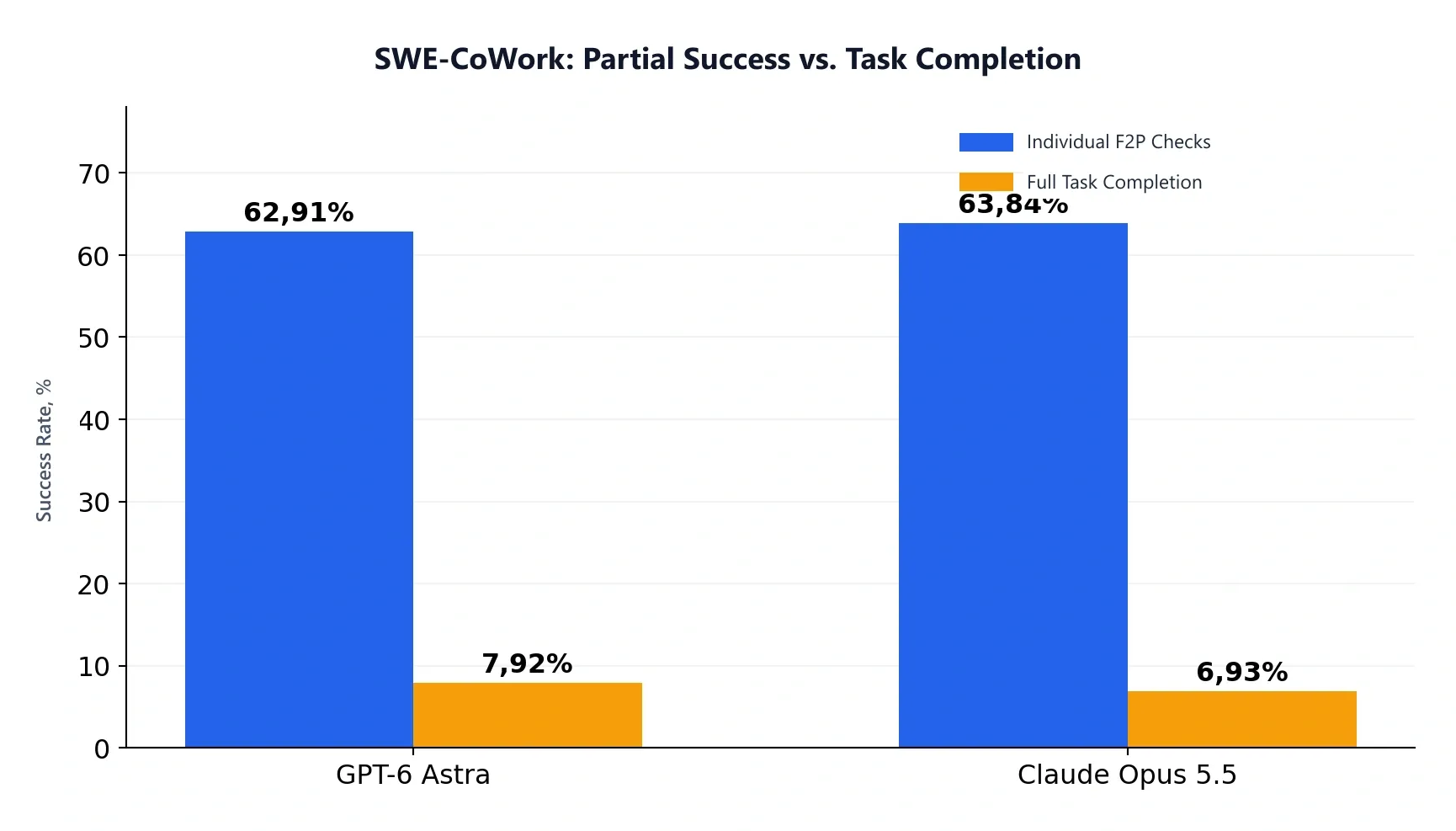
Figure 1. Share of successfully passed functional requirement checks (F2P) versus share of assignments fully passing all test suites. Data: SWE-CoWork.
GPT-6 Astra passed 62.91% of functional requirement checks and fully completed 7.92% of tasks. Claude Opus 5.5 scored 63.84% and 6.93%, respectively. The other nine evaluated models reached at most 39.09% on F2P and 0.99% on fully completed assignments.
Understanding the difference between these metrics is crucial. F2P measures the proportion of passed tests verifying new requested behavior. Full task completion requires all tests—both new features and regression suites for existing behavior—to pass in a single unified run. Consequently, dozens of sound code modifications still result in failure if even a single edge case or requirement remains unaddressed.
Does a Complete Specification Help?
The researchers conducted a dedicated oracle experiment: providing agents with the complete, explicit specification from the outset. In this setup, agents no longer had to gather information from colleagues or unearth hidden requirements from documents.
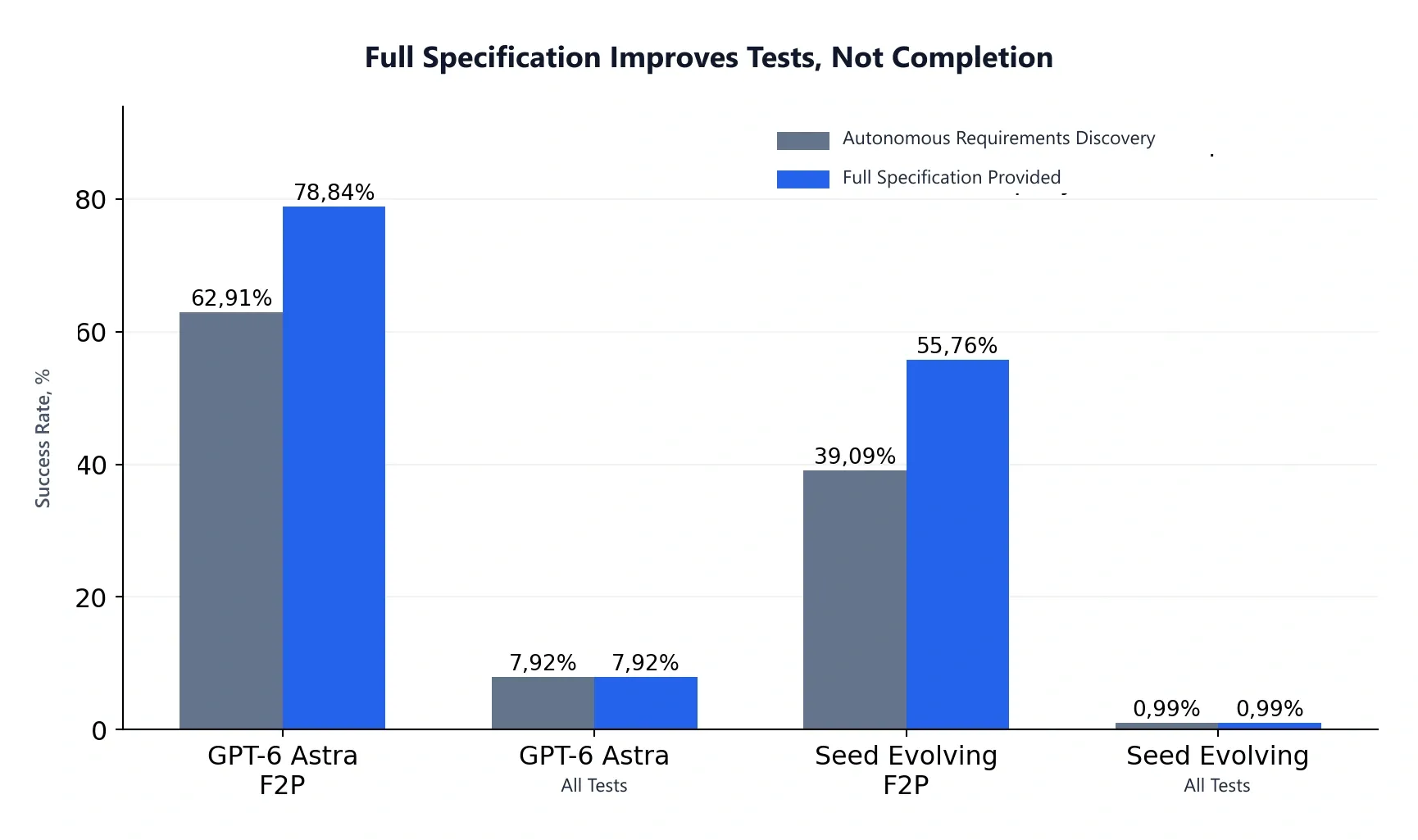
Figure 2. Providing full specifications improves the pass rate of individual checks, but does not increase the share of fully completed tasks. Data: SWE-CoWork.
For GPT-6 Astra, F2P performance jumped from 62.91% to 78.84%—an increase of nearly 16 percentage points. Seed Evolving experienced a similar ~16-point gain. Yet the rate of fully completed tasks remained virtually unchanged: 7.92% and 0.99%, respectively.
This does not suggest that requirements are unimportant. Clear specifications eliminate ambiguity and save time, but they do not solve the fundamental challenge of managing large, interconnected sets of code changes and bringing them to an end-to-end verified state.
Where Agents Fall Short
An in-depth error analysis of Claude Opus 5.5 interaction logs revealed several recurring failure modes. The model proved adept at locating the right specialist: on average, 93% of initial inquiries were directed to the relevant team member. However, it only extracted 64% of the necessary requirements held by those colleagues.
Critical details frequently remained uncovered even after the agent engaged in dialogue with the right person. Inquiries were sometimes postponed and never reopened: out of 450 deferred queries, 153 were never pursued again.
Breakdowns persisted even after requirement gathering. When categorizing failed verification checks, researchers traced 56% to implementation flaws, 42% to questioning and clarification gaps, and just 2% to information retrieval.
Self-reported task completion proved particularly unreliable. Out of 826 requirements Claude declared complete, 255 failed upon evaluation. This represents approximately 31% false completion reports across the examined sample.
Why SWE-bench and SWE-CoWork Tell Different Stories
Traditional software engineering benchmarks serve a valuable purpose: evaluating an agent's ability to fix an isolated bug or implement a clearly defined pull request. SWE-CoWork evaluates an orthogonal set of workplace skills: managing ambiguity, extracting missing context from teammates, tracking commitments, and delivering a cohesive finished product.
These benchmarks should not be ranked against each other as "better" or "worse." They evaluate distinct facets of software engineering. High performance on SWE-bench remains a meaningful achievement, but it does not prove that an agent can operate autonomously as a full-time employee without oversight.
Methodological caveats also apply: the simulated colleagues are synthetic, the tasks are intentionally challenging, and different models ran in differing agent environments (for instance, GPT-6 Astra was run via Codex, while several other models ran via Claude Code). As such, the 7.92% completion rate does not mean AI can only solve 8% of all tasks in a typical engineering team.
What This Means for Practical Software Engineering
These findings explain why engineering teams still encounter unexpected regressions and incomplete PRs even after watching compelling autonomous agent demonstrations. An AI agent might write the core logic flawlessly and pass immediate unit tests, yet overlook a constraint discussed in a thread or unintentionally break existing functionality.
For software teams, this underscores the necessity of clear acceptance criteria, comprehensive automated regression testing, and rigorous tracking of open requirements. Crucially, teams must treat an agent's self-reported success as a claim requiring verification rather than proof of correctness.
Moving forward, meaningful progress will come not only from stronger base foundation models, but also from better tooling for long-horizon task management: commitment tracking, multi-turn state verification, proactive follow-ups on pending questions, and rigorous phase gates.
SWE-CoWork highlights the true scale of autonomous software engineering. AI coding agents can already execute the majority of isolated engineering actions, but transforming those actions into an end-to-end finished product remains a challenging frontier.