
Gemini 2.5 Pro is Google's flagship model, combining speed with deep understanding. It is not just a text model but a full-fledged analyst, researcher, writer and assistant, able to process thousand-page documents, images, code and tabular data in a single request.
What should you keep in mind when writing prompts for Gemini 2.5 Pro?
- Deep understanding and coherent answers: Gemini 2.5 Pro is built with an emphasis on structured thinking. The AI does not simply generate text — the model explains its steps and gives reasoned answers even on complex scientific or legal topics. That makes it especially reliable in scenarios where consistency and logic matter.
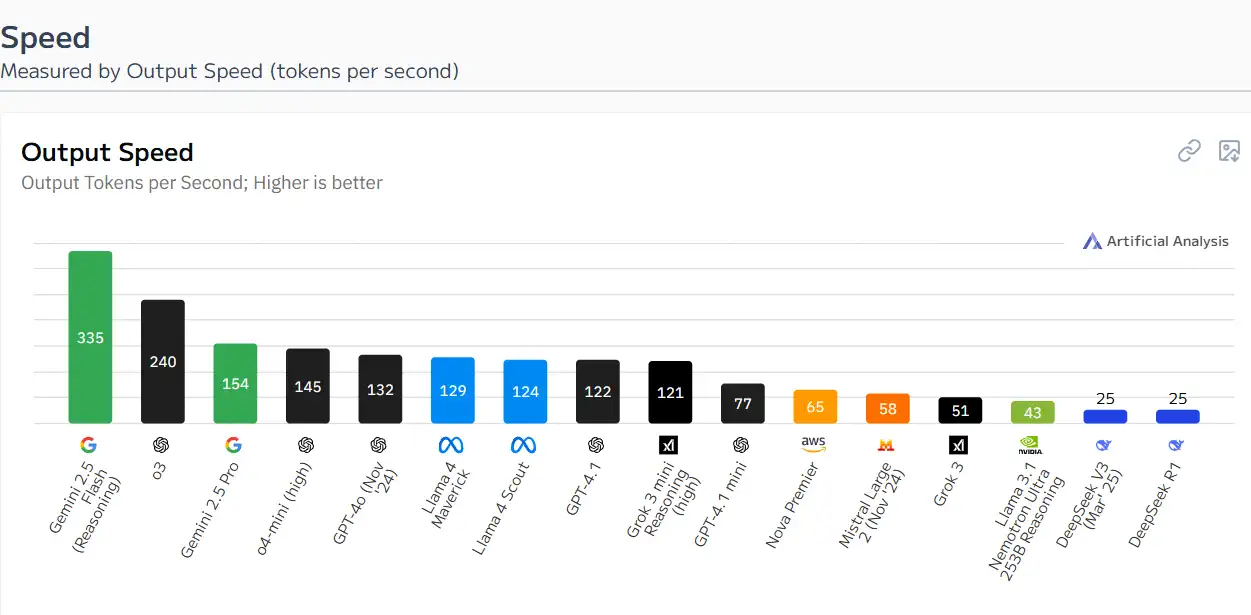
- High-speed mode: Average generation speed is 154 tokens per second according to Artificial Analysis, which makes it a good fit for interactive assistants and for cases where you need an accurate, detailed answer fast.
- A million-token context: One of its key innovations is the model's ability to "remember" and analyze up to 1,000,000 tokens in a single chat. That means you can load an entire book, a technical documentation set or a massive thread of correspondence — and get a meaningful summary, conclusion, article or analysis.
- Text plus images: Gemini 2.5 Pro can analyze charts, photos, interfaces and scanned documents. The model can pull key information out of an image and connect it to your text request — whether that is a UX review, reading a diagram or describing a product from a photo.
How does Gemini 2.5 Pro handle benchmark tasks?
Answering general questions
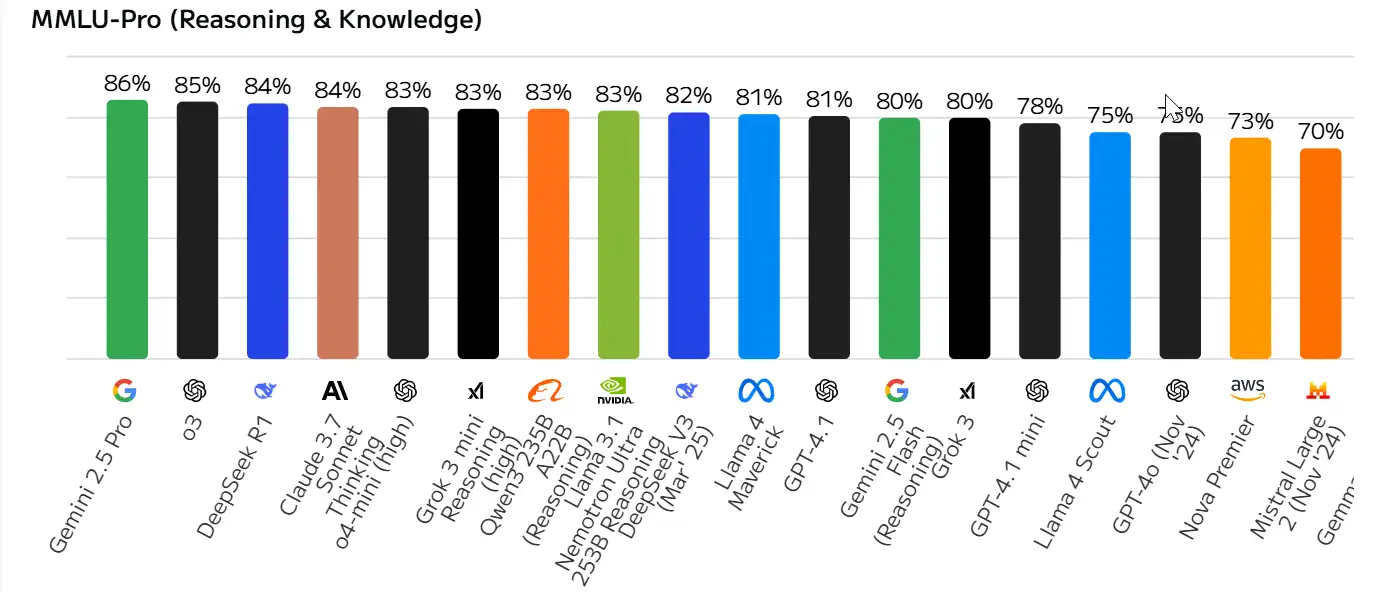
In tests of general comprehension, Gemini 2.5 Pro takes the leading positions. Take the MMLU-Pro benchmark, for example — an evaluation system that tests an AI's abilities by asking it to solve 12,000 tasks across 14 different subjects. Here the model reached an impressive result, a success rate of 86%, ahead of competitors such as o3, DeepSeek R1 and Claude 3.7 Sonnet Thinking.
Source: Artificial Analysis
Coding
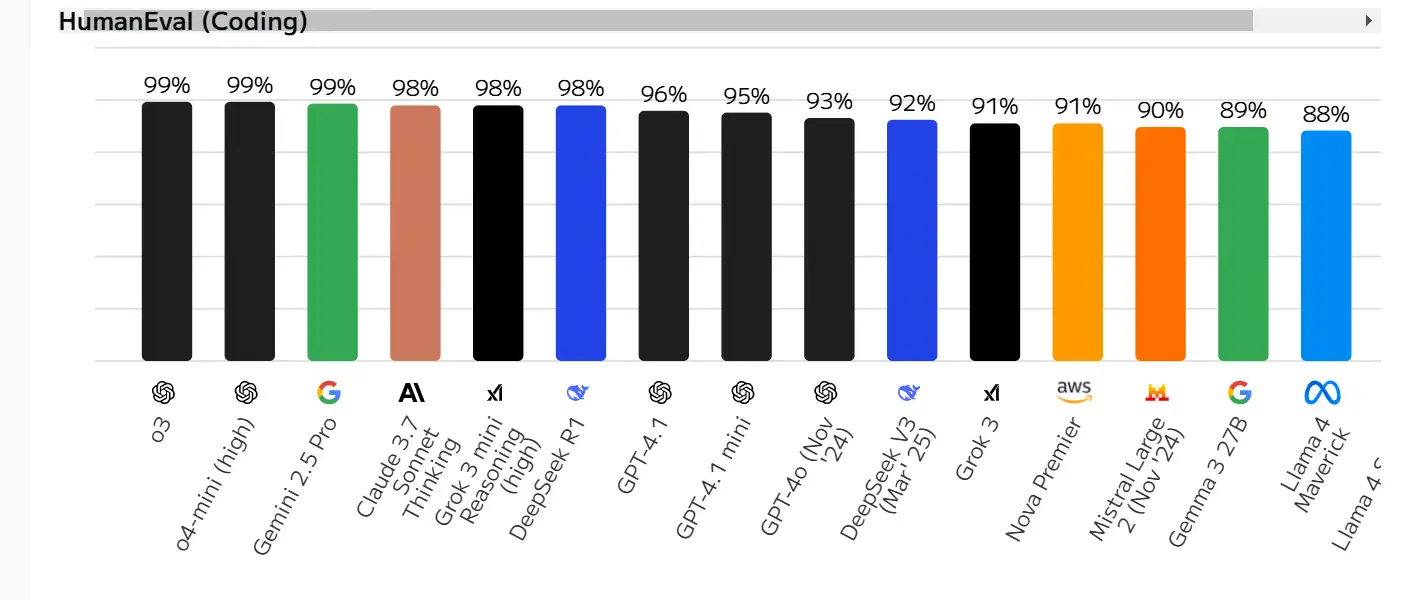
Gemini 2.5 Pro is among the leaders for coding quality, scoring 99% on the HumanEval benchmark. The model beats most competitors and stays level with models such as o3 and o4-mini-high.
Source: Artificial Analysis
Mathematics
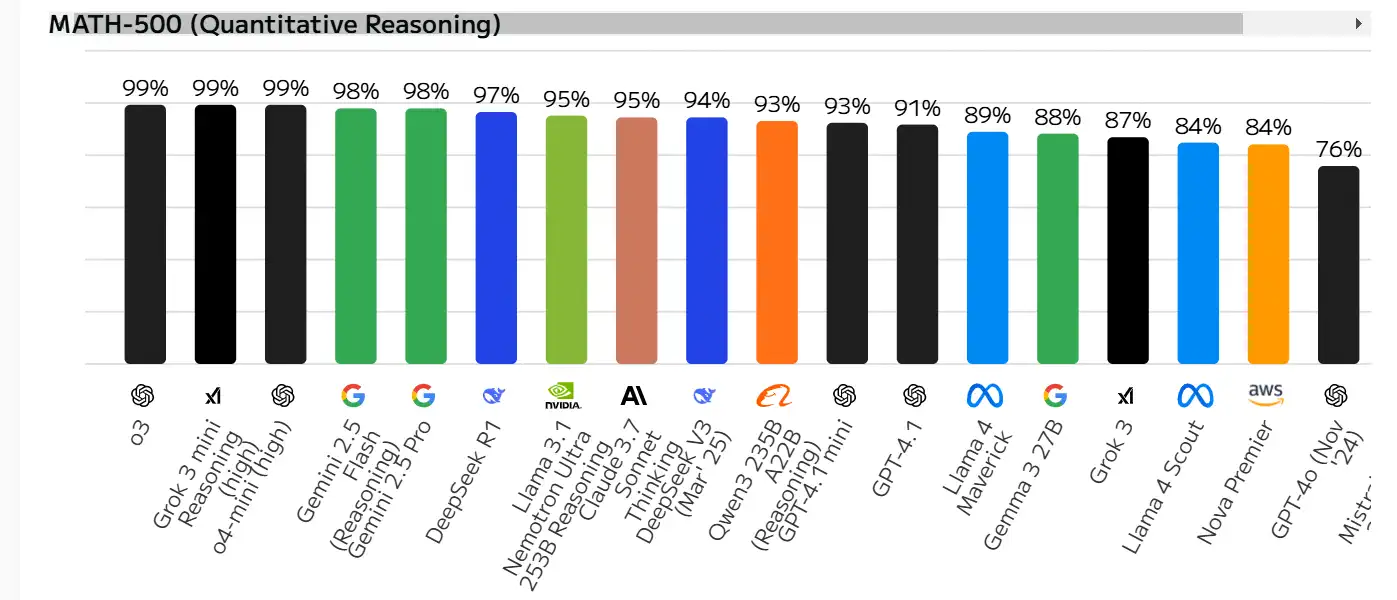
Gemini 2.5 Pro handles mathematical problems very well. On the MATH-500 test, where models have to solve 500 advanced problems in algebra, geometry, arithmetic and other branches of mathematics, the model scored 99% of tasks solved correctly.
Source: Artificial Analysis
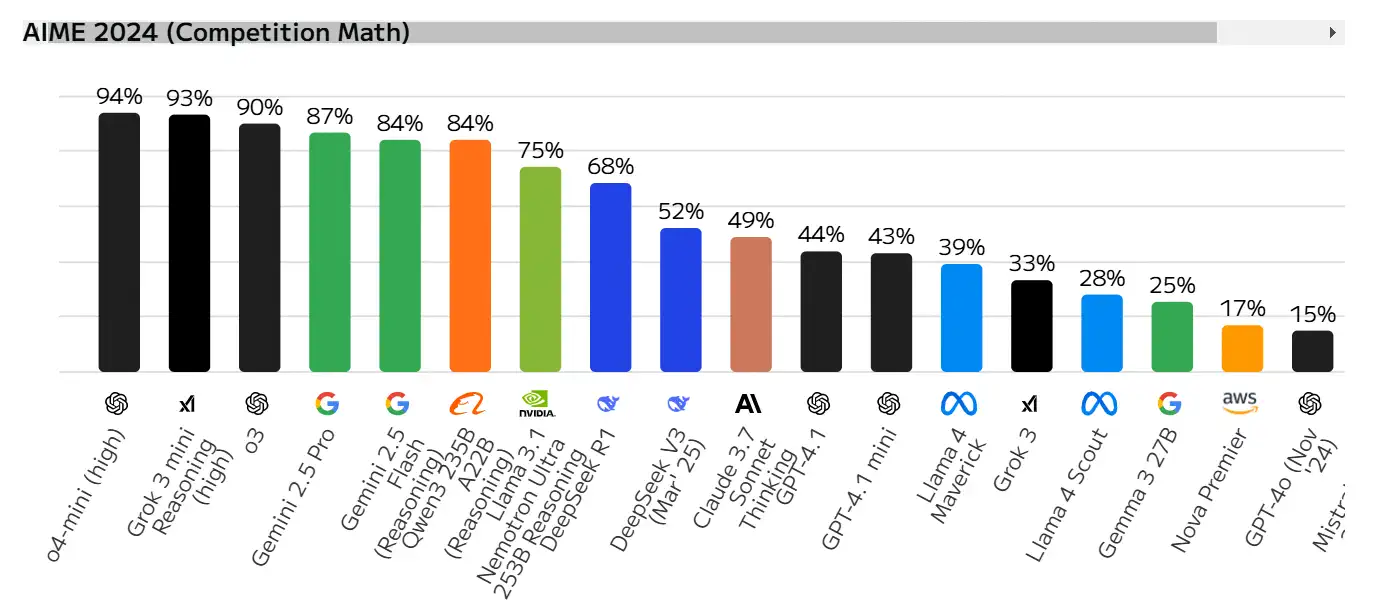
On another test — AIME 2025, based on problems from the American Invitational Mathematics Examination — Gemini reached 87% accuracy, taking 4th place overall. This test includes 14 extremely hard olympiad problems with numeric answers and no multiple choice, and it tests a model's capacity for creative solutions that go beyond standard methods.
Source: Artificial Analysis
Generation speed
Gemini 2.5 Pro reaches output speeds of up to 154 tokens per second, making it the third fastest of all models in the Artificial Analysis Speed test. That means the model can be used in real-time scenarios — chats, customer support, text generation.
Source: Artificial Analysis
Prompting tips
1. Step-by-step thinking: ask it to explain its reasoning
Gemini 2.5 Pro performs well when you tell it clearly: "explain step by step", "break the task into stages" or "show your intermediate reasoning". This activates its planning mode and leads to more logical, transparent answers. It matters most when you are working with analytics, mathematics and legal texts.
2. Compressing context: help the model find what matters
Even with support for up to a million tokens of context, Gemini works more efficiently when you highlight the key data. Use headings, lists and explanatory blocks. That helps the model concentrate on the main task instead of spreading its attention across secondary fragments of text.
Formatting helps (JSON, Markdown, XML), as do prompt elements: role, context, task, output format. Read in the prompt engineering guide about how to phrase a prompt.
Tip: Give a short summary before a large attachment, especially if you are adding a PDF, code or a long dialogue.
3. Avoid ambiguity: structure beats volume
The more precisely a request is built, the higher the accuracy. If the question contains vague terms or fuzzy wording, Gemini may generate a less relevant answer — especially with multimodal input. In our guide we have collected and explained all the main elements a prompt is made of.
Tip: Phrase instructions the way you would for an assistant: You are a financial analyst, Return a 3-bullet summary in Markdown and so on.
Examples of tasks Gemini 2.5 Pro can handle
1. Deep understanding and coherent answers
This strength highlights the model's capacity for structured thinking, explaining its steps and delivering reasoned answers, especially on complex topics.
Prompt 1:
Analyze the following ethical dilemma: 'A company has discovered that one of its popular products carries a small but real health risk for a small group of consumers. Recalling the product will cost millions and damage trust. Concealing the information could lead to lawsuits and reputational damage later.' Present the arguments for and against each possible decision (recall the product, do not recall the product, disclose to a limited degree). Explain the logic of each step in your reasoning and propose the most ethically justified decision, explaining your choice. Read the generated result →
Comment: This prompt requires the model not merely to give an answer but to run a deep analysis of a complex situation with several variables. It engages the capacity for structured thinking and for justifying conclusions, which is critical for complex scientific or legal topics.
Prompt 2:
Explain the concept of 'quantum entanglement' as if you were explaining it to a first-year humanities student with no prior knowledge of physics. Split the explanation into key ideas, using analogies or examples for each. It is important that the explanation is consistent and that every new point follows logically from the previous one. Read the generated result →
Comment: This prompt targets the model's ability to adapt complex scientific concepts for an unprepared audience while preserving the logical structure and flow of the explanation. It demonstrates deep understanding and the ability to explain its steps.
2. High-speed mode
This characteristic (154 tokens per second) makes the model a good fit for interactive tasks that need a fast, detailed answer.
Prompt 1:
I am preparing a presentation on artificial intelligence trends for 2025. Generate 15 talking points for the slides, covering various aspects: from technical breakthroughs to ethical questions. I need a quick draft to get started. Read the generated result →
Comment: The prompt asks for many ideas in a short time. The high response speed lets you get material for further work quickly, which is ideal for interactive assistants and for cases where you need an accurate, detailed answer fast.
Prompt 2:
Summarize the contents of this article [paste the full text of the article on artificial intelligence from Wikipedia in Markdown format] in five main points. I need to understand the key takeaways very quickly. Read the generated result →
Comment: This prompt demonstrates the use of high speed and a large context window to extract the essence of a text quickly. It is useful in situations where there is no time to read the full material.
3. A million-token context
This innovative capability lets the model analyze huge volumes of information (up to 1,000,000 tokens) in a single request — books, technical documentation or long correspondence.
Prompt with a long text:
[Paste the file with the full text of OpenAI's GPT-4.1 prompting guide]. Analyze this document and prepare a detailed summary (roughly 800 words), highlighting the key methodologies, results, conclusions and recommendations. Also point out any limitations of the research mentioned by the authors. Read the generated result →
Comment: This prompt uses the document-processing capability directly. The model has to remember and analyze the whole body of text to produce a meaningful summary. You can add a short summary before a large attachment, for example: This is research on the impact of climate on agriculture. I need a detailed summary of it.
In summary
The versatility of Gemini 2.5 Pro opens genuinely broad horizons for users across very different fields. The model understands and analyzes colossal volumes of data, including text, code and files. It is an excellent tool for researchers, analysts and developers.
The ability to get logically constructed, reasoned answers backed by a step-by-step explanation is especially valuable in complex scientific, technical and legal tasks, where accuracy and consistency play a key role.