
This guide is for anyone who wants to master music generation with artificial intelligence. You will learn how to work with the Suno neural network, how to write effective prompts for creating music, get to know meta tags, and pick up the best practices for using AI music tools to reach professional results.
This guide will be useful for:
- Musicians who want to widen their creative toolkit
- Marketers working on advertising content
- Content creators for social media and other outlets
- Game and app developers who need unique sound design
- Anyone interested in modern music generation technology
In an age of information overload, advertising faces a serious challenge — it is losing its effectiveness. Modern marketers look for new ways to grab and hold the attention of an audience, and often turn to unconventional, sometimes even shocking solutions. Music plays a key role in this process: it can burrow into a consumer's subconscious and build a strong associative link with a brand.
SUNO is a universal music generator powered by AI and built on the Bark and Chirp models for generating vocal and musical elements. It lets you create a wide variety of tracks adapted to specific needs. It supports different genres and styles of music.
Comparison with traditional methods
Traditional music creation:
- Takes a significant amount of time
- Requires professional skills
- Studio recording is expensive
- Limited by human capabilities
AI generation:
- Fast creation of many variants
- Available even to non-specialists
- Cost-effective
- Unlimited room for experiments
Examples of successful use
- Creating background music for commercials
- Generating jingles and sound logos
- Producing music for social media
- Creating soundtracks for video content
- Generating musical beds for podcasts
Examples of musical pieces
Songs
Jingles
Background music
Simple prompt
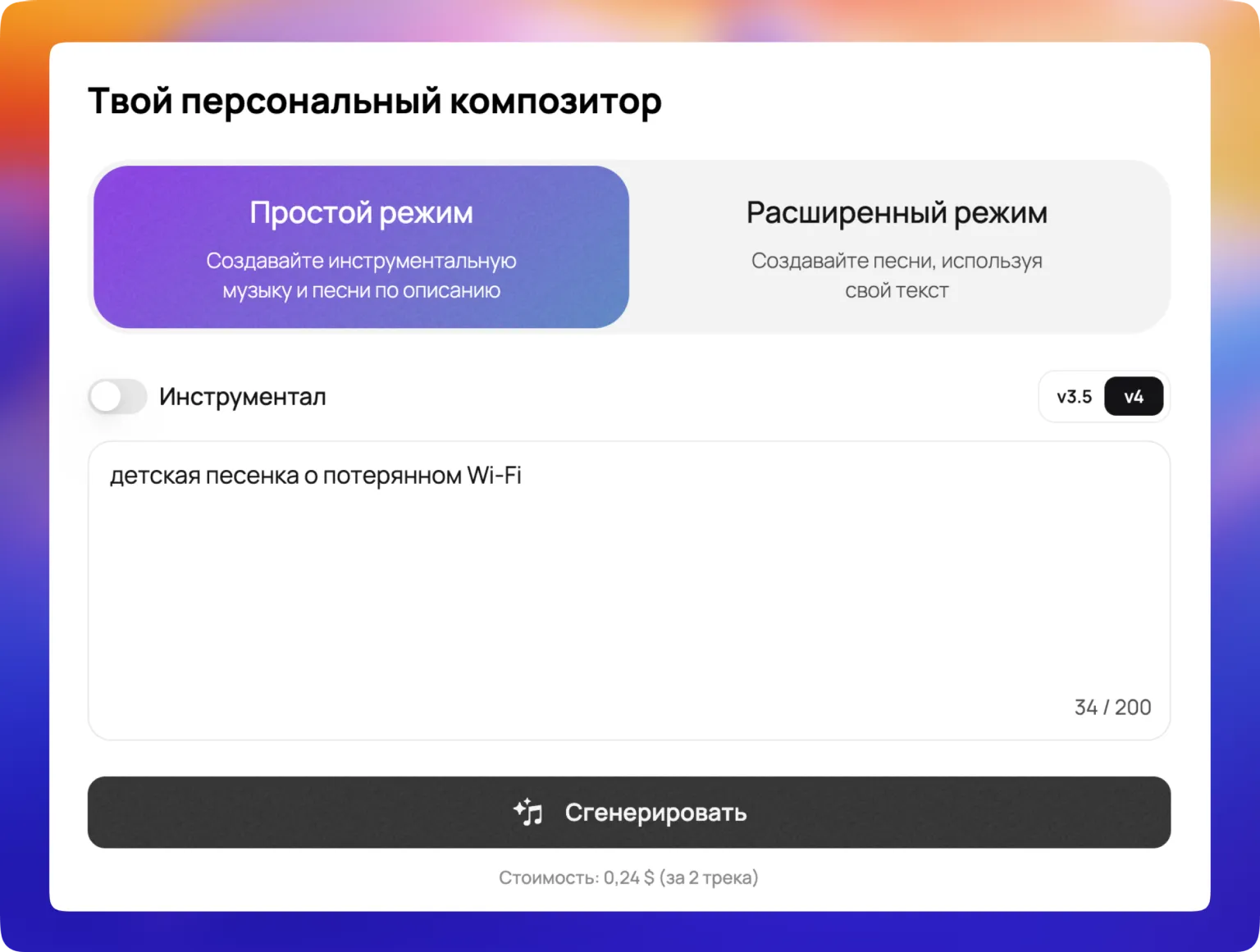
An example of a request in the "Simple mode" of Suno v4
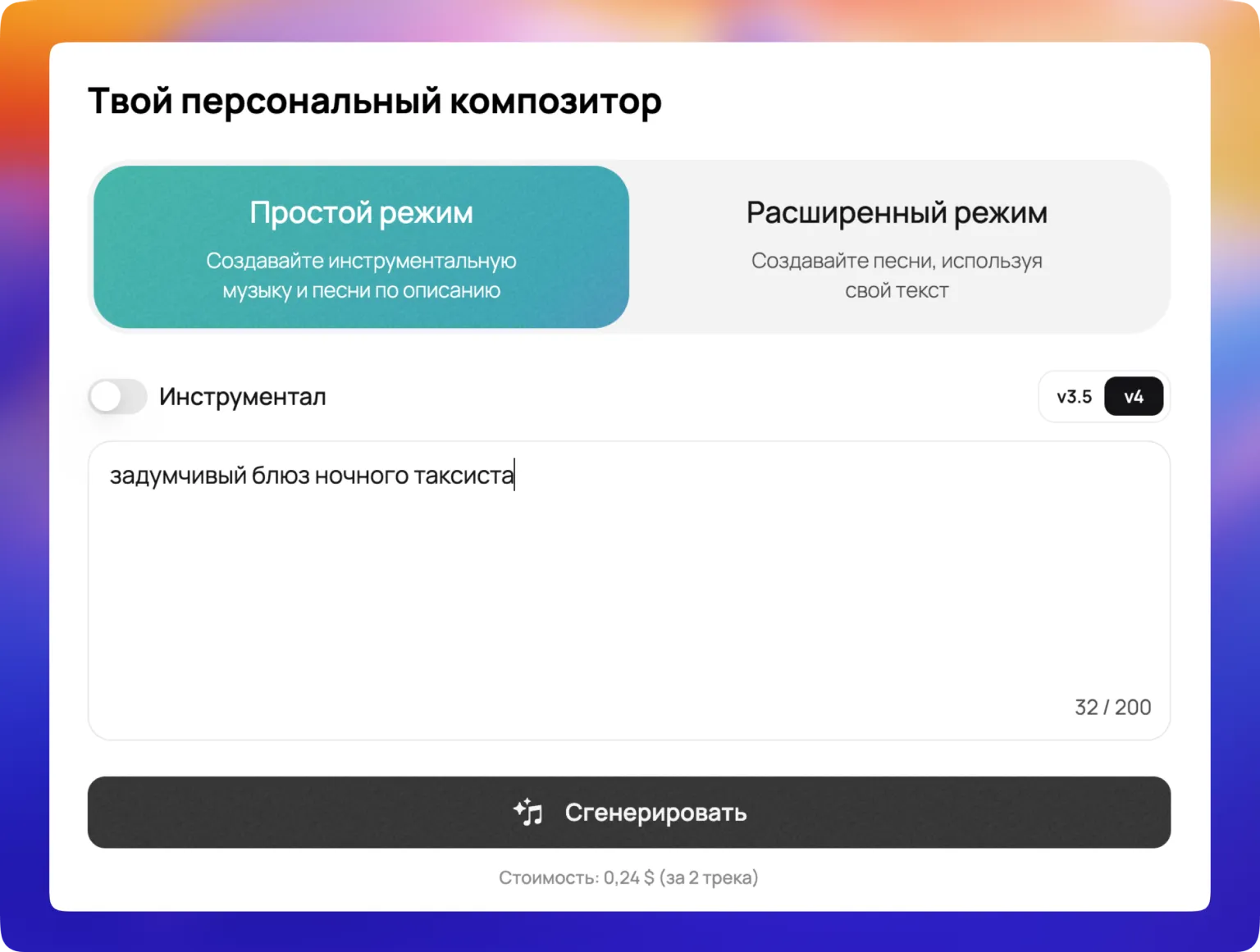
Generating a song in the "Simple mode" of Suno in GPTunneL
Usage tips:
- A simple prompt can generate random lyrics and a random musical style
- Come up with a story or an idea for the song
- State the mood and the genre
Advanced prompt
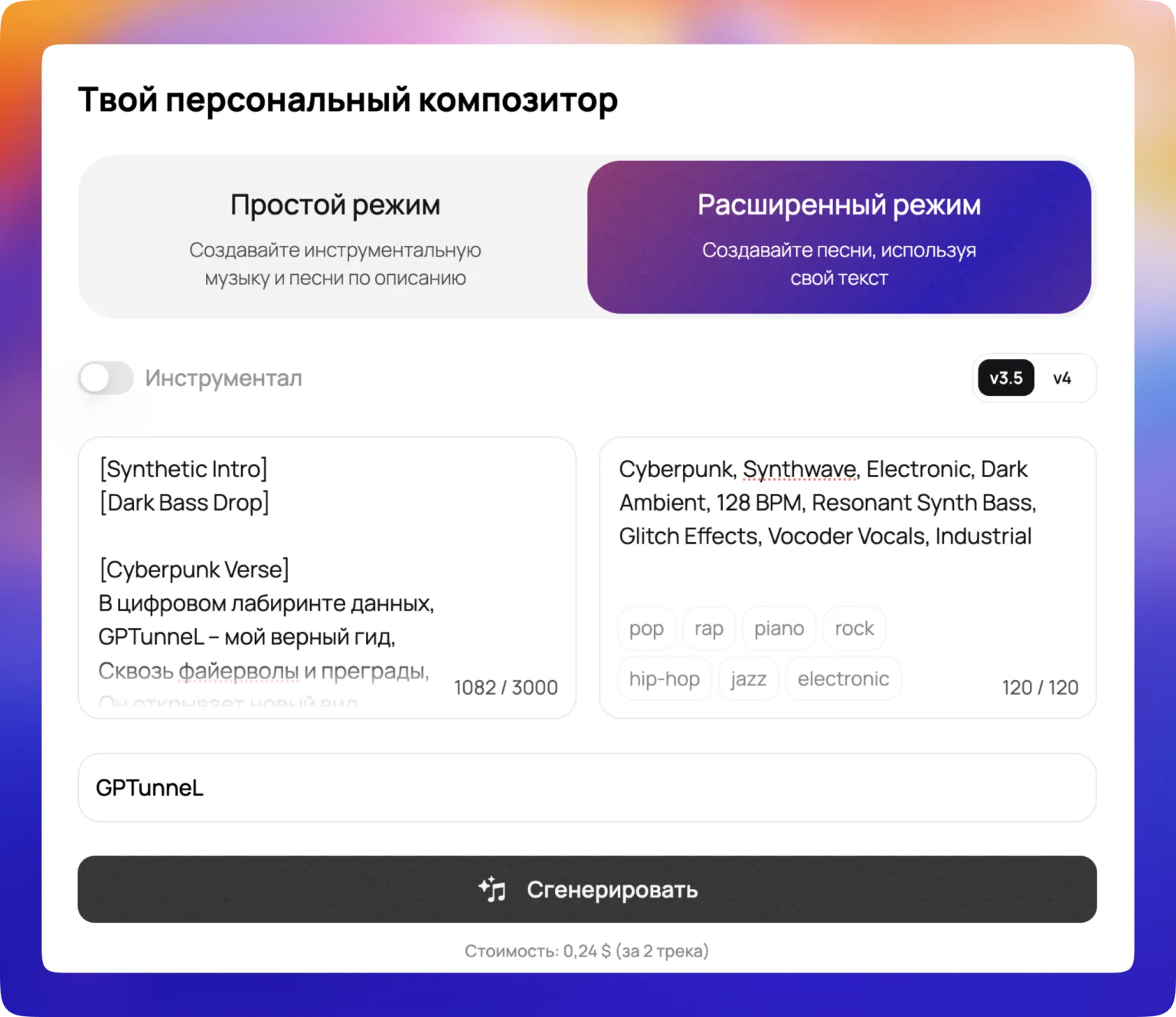
In advanced mode you can specify the song lyrics and the style of the composition
Music genres
In advanced mode you can write genres, instruments and tempo into the Style field, and optionally the mood of the song. There are a huge number of genres. Here are the best known ones, which come up often in generations.
Pop (BPM: 90-110)
- Dance Pop: Electropop, K-Pop, Indie Pop, Synthpop, Art Pop
- Latin Pop: Bubblegum Pop, Hyperpop, Bedroom Pop
Electronic (BPM: 120-130)
- House: Ambient, B-Bit, EDM
- Techno: Dubstep, Drum And Bass
- Trance: Lo-Fi
Hip-Hop (BPM: 85-115)
- Rap: Drill, Cloud Rap, Emo Rap
- Trap: Grime, Mumble Rap
- Crunk: Gangster Rap, Boom Bap
R&B (BPM: 60-80)
- Soul: Quiet Storm, New Jack Swing
- Neo Soul: Trap Soul, Black Comedy
- R&B: Funk, Gospel, Motown
Latin (BPM: 90-220)
- Reggaeton: Latin Pop, Bolero
- Salsa: Corrido, Tropical
- Bachata: Cumbia, Merengue, Sierreño
Rock (BPM: 110-140)
- Classic Rock: Ska, Surf Rock
- Hard Rock: Grunge, Glam Rock
- Alternative Rock: Britpop, Indie Rock
Metal (BPM: 124-200)
- Heavy Metal: Progressive Metal
- Thrash Metal: Doom Metal
- Death Metal: Symphonic Metal, Nu Metal
Do not be afraid to mix genres and play with arrangements! It is exactly in creative experiments that the unique melodies and sounds are born which become hits and stay in listeners' hearts.
Tempo
Here is a catalog of traditional musical tempos and their BPM ranges, originating in the baroque and classical eras. Systematized originally by Italian musicians, these markings became a universal language for indicating performance speed in both classical and modern music. Keep in mind that the actual tempo of generated music may vary slightly from the values given in the prompt.
BPM (beats per minute) ranges
Very slow
- Grave: 20-40 BPM
- Largo: 40-60 BPM
- Larghetto: 60-66 BPM
Slow
- Lento: 45-60 BPM
- Adagissimo: 40-60 BPM
- Adagio: 66-76 BPM
Walking pace
- Largamente: 60-80 BPM
- Andante: 76-108 BPM
- Andantino: 80-108 BPM
Moderate
- Andante moderato: 92-112 BPM
- Moderato: 108-120 BPM
- Allegretto: 112-120 BPM
- Tempo comodo: 80-100 BPM
Fast
- Allegro moderato: 116-120 BPM
- Allegro: 120-168 BPM
- Allegro vivace: 132-140 BPM
- Vivace: 140-176 BPM
- Allegro assai: 160-168 BPM
- Molto allegro: 168-176 BPM
Very fast
- Vivacissimo: 172-176 BPM
- Allegrissimo: 172-176 BPM
- Presto: 168-200 BPM
- Prestissimo: 200+ BPM
Examples of tempo use in different styles:
- Indie Funk:
- Cry Guitar, Groovy Bass Guitar, Turntable, Drum Machine, Male Vocie
- 130 Bpm
- Major key
- Jazz Fusion:
- Scat Vocals, Slap Bass, Rhodes Piano, Trumpet, Drum Kit
- 120 Bpm
- Lydian mode
- Synthwave:
- Analog Synth, Gated Reverb, Drum Machine, Vocoder, Arpeggiator
- Allegretto Tempo
- Minor key
- Folk Rock:
- 12-string Guitar, Harmonica, Mandolin, Cajon, Male/Female Duet
- Allegro Tempo
- Major key
Emotional styles
Emotional coloring is a key element of a musical composition: it strengthens the impact of the lyrics and shapes the overall impression of the piece. You can set it both for individual parts of the song and in the description of the overall style after the genre. A well-chosen emotional tone not only enriches the composition and makes it more dynamic, but also creates a particular psychological response in the audience. When choosing the emotional coloring for different parts of a song, it is worth keeping it in line with the content of the lyrics, unless you are deliberately going for a post-ironic effect.
Positive
- Happy
- Joyful
- Uplifting
- Euphoric
- Energetic
- Bouncy
- Powerful
- Empowering
- Playful
- Upbeat
Calm
- Calm
- Mellow
- Soothing
- Relaxing
- Chill
- Atmospheric
- Ambient
- Ethereal
- Dreamy
- Smooth
Melancholic
- Melancholic
- Sad
- Sentimental
- Anxious
- Restless
- Dark
- Reflective
Intense
- Acid
- Aggressive
- Angry
- Epic
- Dramatic
- Mysterious
- Eerie
- Quirky
- Whimsical
- Psychedelic
- Bright
- Sultry
- Cathartic
For a vivid and memorable result, it is worth experimenting with contrasting emotional shades within a single piece.
Examples of use in song sections
- [Whimsical Powerful Verse]
- [Quirky Interlude]
- [Epic Guitar Solo]
- [Catchy Hook]
Example:
[Melancholic Guitar Intro][Soft Rain Ambience]
[Minor Blues Verse]
In the night stream of streetlights,
I roll on through the city of shadows.
Hour after hour behind the wheel,
I catch somebody's tired gaze.
[Bluesy Break]
(Mm-mm-mm...)
[Minor Blues Verse]
Fates flicker by in the mirrors,
Stories of the things they've done.
Someone is driving away from love,
Someone toward it — turn here, drive on.
[Soulful Pre-chorus]
And every evening, like a film,
I watch the canvas of a life.
I keep the secrets of strangers,
As if I guarded them myself.
[Melancholic Chorus]
The night cab driver — a silent witness
Of chance encounters and goodbyes.
The night cab driver — a keeper of fate,
A collector of other people's confessions.
[Jazz Blues Interlude]
[Saxophone Solo]
[Deep Blues Verse]
The cabin smells of cigarettes,
And of wine left unfinished.
And I hold on to someone else's secret,
Until tomorrow's sleep.
[Emotional Bridge]
Under the rustle of tires a river flows
Of unlived stories.
And I drift in from far away
On a current of somebody's sorrows and grief.
[Melancholic Chorus]
The night cab driver — a silent witness
Of chance encounters and goodbyes.
The night cab driver — a keeper of fate,
A collector of other people's confessions.
[Slow Fade Out]
(The sound of rain and distant car horns...)
[Whispered End]
"Where are we going?"...
Vocal meta tags
Vocal meta tags are important tools for shaping the exact characteristics of a vocal performance: they define timbre, vocal techniques and the singer's emotional delivery. For a harmonious sound, choose vocal meta tags that match the musical genre, the emotional style and the overall atmosphere of the piece.
Female vocal characteristics
- Melodic
- Ethereal
- Dulcet
- Soulful
- Lyrical
- Soothing
- Expressive
- Mellifluous
- Breathy
- Crystal-clear
Male vocal characteristics
- Robust
- Guttural
- Gravelly
- Sonorous
- Deep
- Resonant
- Raspy
- Powerful
- Brassy
- Piercing
General vocal styles
- Female Narrator
- Diva Solo
- Gospel Choir
- Gregorian chant
- Melismatic
- Narration
- Spoken Word
- Sprechgesang
- Emotional
- Sultry
- Resonant
- Ethereal
- Lounge Singer
- Vocaloid
That said, do not box yourself in with strict rules — creative experiments with unusual combinations of meta tags can lead to interesting and original results.
Examples of use
- [Female Narrator]
- [Diva Solo]
- [Gospel Choir]
- [Primal Scream]
(oh-oh-oh) Backing vocals or a sing-along part — instead of "oh-oh-oh" it can be anything
Musical instruments
The list of instruments below reflects only a small part of the rich musical toolkit available to humanity. Although the model automatically picks instruments typical of a genre when you name one, you can control the instrumentation more precisely by writing the instruments you want explicitly into the prompt. Do not be afraid to experiment with unusual instrument combinations — it can lead to an original and unique sound. Non-standard use of traditional instruments often becomes a source of creative discoveries in music production.
Keyboards
- Piano
- Synthesizer
- Electric piano
- Organ
- Harpsichord
- Accordion
- Melodica
- Celesta
- Rhodes piano
- Wurlitzer
- And other specialized instruments
Strings
- Acoustic guitar
- Electric guitar
- Bass guitar
- Violin
- Cello
- Viola
- Double bass
- Banjo
- Mandolin
- Harp
- And many ethnic string instruments
Wind
- Saxophone
- Trumpet
- Trombone
- Clarinet
- Flute
- Oboe
- Bassoon
- French horn
- And other wind instruments
Electronic
- Drum machine
- Groove box
- Vocoder
- Modular
- Theremin
- Laser harp
Usage tips:
- Experiment with different combinations of instruments
- Remember that even non-traditional use can lead to interesting results
Keep in mind, however: too many instruments, especially ones not typical of the chosen genre, can hurt the quality of the mix, adding unwanted noise and breaking its coherence.
Musical and technical devices
Before you put musical devices into your prompts, it is worth looking up how they sound online. Even though the current capabilities of the neural network do not allow precise control over specific chords or notes, the set of musical devices below gives you enough tools to build impressive compositions even without deep knowledge of music theory.
Harmony
- Diatonic
- Enharmonic
- Harmonized
- Chromatic
- Dissonant
- Harmonic
- Melodic
- Microtonal
- Modulated
- Negative Harmony
- Reharmonized
- Minor key
- Major key
- Chromatic scale
Rhythm and tempo
- Groovy
- Funky
- Bluesy
- Backbeat
- Cadenced
- Crescendoing
- Downbeat
- Ostinato
- Rhythmic
- Rubato
- Syncopated
- Quantized
Sound effects
- Looped
- Octaved
- Pitch-shifted
- Tremolo
- Vocoded
- Synthetic
Performance technique
- Acoustic
- Arpeggiated
- Fingerstyle
- Bluesy
- Contrapuntal
- Glissando
- Legato
- Monophonic
- Orchestral
- Percussive
- Polyphonic
- Staccato
Examples of use:
- [Syncopated Bass]
- [Funky Intro]
- [Melodic Piano]
- [Major Verse]
- [Fingerstyle Guitar Solo]
- [Reharmonized Chorus]
Musical artists and styles
Neural networks for creating music are trained on a vast base of musical works from all over the world, which lets them imitate the style of almost any artist. The list of artists and bands below is only a small part of the possible stylistic reference points.
There are several approaches to imitating a particular musical style:
- Naming the artist directly (for example, "ABBA Style")
- Describing the characteristic musical elements in detail using technical terms
- A combined method that names the artist, describes the style and specifies the arrangement (the character of the instrumental sound and the vocal performance)
Which approach you choose depends on your goals and on how much control you want over the result of the generation.
Examples of style descriptions for well-known artists
Rock and alternative
- AC/DC: Hard Rock, Stomp
- Arctic Monkeys: Indie Rock, Garage, Cool
- Black Sabbath: Heavy Metal, Doom
- Coldplay: Alternative Rock, Atmospheric
- Nirvana: Grunge, Dark, Raw, male vocals
Pop and electronic
- Adele: Soul, Emotional, Torch-Lounge, female vocals
- Ariana Grande: Pop, Dance Pop, Ethereal, female vocals
- Lady Gaga: Pop, Theatrical, Dance, female vocals
- Madonna: Dance Pop, High BPM, female vocals
- Dua Lipa: Disco, Dance Pop, Groovy, female vocals
Hip-hop and R&B
- Jay-Z: HipHop, Aggressive, Storytelling, male vocals
- Kanye West: HipHop, Progressive, Eclectic, male vocals
- Beyoncé: RnB, Rythmic, Danceable, female vocals
Rock legends
- The Beatles: UK British Pop, Classic, Rock
- Led Zeppelin: Hard Rock, Blues Rock, Epic
- Pink Floyd: Rock, Progressive, Atmospheric
- Queen: Rock, Operatic, Theatrical, male vocals
Contemporary artists
- Ed Sheeran: Folk, Acoustic Guitar, male vocals
- Billie Eilish: Pop, Dark, Minimal, female vocals
- Post Malone: Pop, Ethereal, Ambient, male vocals
- Taylor Swift: Pop, Alternative Folk, Emotional, female vocals
Song structure: the main elements
By building the structure of your song correctly, you increase the chance of a successful generation with the right dramatic arc and fewer artifacts (repeated sections)
Intro
- [Intro]: a general intro
- [Instrumental Intro]: an instrumental intro
- [Short Instrumental Intro]: a short instrumental intro
Verse
- [Verse]: a standard verse
- [Rapped Verse]: a rapped verse
- [Minor Sad Verse]: a sad verse in a minor key
Pre-chorus
- [Pre-chorus]: a standard pre-chorus
- [Post-chorus]: a post-chorus
- [Whimsical Pre-chorus]: a whimsical pre-chorus
- [Melodic Upbeat Pre-chorus]: a melodic, upbeat pre-chorus
Chorus
- [Chorus]: the main chorus
- [Powerpop Chorus]: an energetic pop chorus
- [Re-Harmonisation Hook Chorus]: a chorus with changed harmony
Bridge
- [Bridge]: a standard bridge
- [Shout Bridge]: an expressive bridge
- [Arpeggiated Melancholy Bridge]: an arpeggiated melancholic bridge
Ending
- [Outro]: a standard ending
- [Big Finish]: a big finish
- [Fade Out]: a gradual fade
- [End]: an abrupt ending
- [Fade to End]: a smooth ending
- [Coda]: a coda
Additional elements
- [Hook]: a memorable phrase or instrumental part
- [Riff]: a repeating musical phrase
- [Break]: a short pause
- [Drop]: a moment where the dynamics change
- [Interlude]: an intermediate part
- [Instrumental Interlude]: an instrumental insert
- [Refrain]: a repeating part of the lyrics
Musical forms
As extra information about what the AI musician is capable of, we suggest getting familiar with musical forms and examples.
The main forms and their structures
Strophic (AAA)
- The song consists of one repeating section
- Often found in church music and national anthems
- A simple repeating structure
Binary (ABAB)
- Alternating verses and choruses
- Examples: Eagles – Hotel California, Jimi Hendrix – Foxy Lady
- The classic form for popular music
Ternary (ABEABC)
- Verse-Pre-chorus-Chorus
- A widespread form with a contrasting third section added
- Examples: Bob Dylan – Like a Rolling Stone, The Beatles – Lucy In The Sky With Diamonds, Adele – Hello
Theme with a bridge (ABABE)
- Verse-Chorus (x2) + Bridge or Coda (Ending)
- Examples: The Beatles – Hey Jude, Huey Lewis & The News – The Power Of Love
32-bar form (AABA)
- A popular form in jazz and pop music
- Sections separated by a Middle 8
- Examples: The Beatles – Something, Judy Garland – Over the Rainbow, Green Day – Wake Me up When September Ends
Rondo (ABAC)
- The classic musical-theatre form
- Examples: Bing Crosby – White Christmas
Motet (ABCD)
- A polyphonic vocal composition on a religious text
- Examples: Queen — Bohemian Rhapsody
Blues (AAB)
- The 12-bar structure characteristic of the blues
- The traditional blues progression
Arch (ABCBA)
- A symmetrical form with a central climax
- A mirrored structure of the composition
Medley (ABCDEF)
- A sequence of different melodies or songs
- A composite piece made of different themes
When you enter a prompt, you can write in a musical form (for example, AABA), and the neural network will build the sequence of sections in line with that form
FAQ:
Q: How long does it take to generate one track?
A: On average 1 minute, depending on how complex the request is.
Q: Can the generated music be used commercially?
A: Yes, all rights to the generated tracks belong to the user.
Q: How can I improve the quality of the vocals?
A: Use clear instructions about the vocal style and do not overload the lyrics with complicated words.
Q: Can I generate an instrumental version of an existing song?
A: No, SUNO creates only original compositions.
You can check the pricing here gptunnel.ai/prices