
The GPTunneL team has put together a detailed guide to one of the more interesting language models available on our platform — YandexGPT-5. This model, built by Yandex, opens up a great deal, especially for Russian-speaking users.
The goal of this guide is to teach you how to write effective prompts for YandexGPT-5, so you can get the most out of the model and solve your work and creative tasks faster and better.
Who is this guide for?
- For beginners: if you are only just getting acquainted with YandexGPT-5, we will help you understand the basics and take your first steps.
- For experienced users: if you already work with LLMs, you will find advanced techniques here and tips on optimizing prompts specifically for YandexGPT-5.
Let's dive into the world of prompt engineering together!
An overview of YandexGPT-5 on GPTunneL
YandexGPT-5 is a language model from Yandex. It is trained on a huge body of text and can handle a wide range of natural language tasks:
- Text generation: articles, posts, letters, poems, scripts, marketing copy and much more.
- Information analysis: summarization, extracting key facts, sentiment detection, topic analysis.
- Answering questions: finding information in a supplied text or drawing on the model's general knowledge.
- Translation: especially strong between Russian and English.
- Help with study and work: explaining difficult topics, generating ideas, checking texts.
The main distinguishing feature of YandexGPT-5 is its grasp of Russian in all its forms, including cultural specifics, idioms and stylistic nuance.
On the GPTunneL platform the model comes in two main versions:
- YandexGPT-5 32K: the flagship version with a huge context window of up to 32,000 tokens. That means the model can "remember" and process large volumes of text (dozens of pages!) within a single dialogue or request. Ideal for working with documents, long articles and complex instructions.
- YandexGPT-5 2K — the Lite version: a lighter, faster and cheaper version with a context window of about 2,000 tokens. Suitable for short requests, quick answers, simple tasks and scenarios where speed and cost matter.
Note: a token is roughly 3-4 characters in Russian. 32,000 tokens is about 100,000 characters of text.
The strengths of YandexGPT-5
Why is this model worth your attention?
- Optimized for Russian: the model generates and understands Russian text well, accounting for grammatical, stylistic and cultural specifics. That makes it an effective tool for tasks in Russian.
- Following instructions: given a clearly formulated prompt, YandexGPT-5 follows the assigned task reliably.
- Large context (in the 32K version): the ability to process up to 32,000 tokens lets you work effectively with bulky texts: analyze large documents, maintain long dialogue context and generate long, coherent texts.
- Versatility: the model suits a wide variety of tasks, including generating text in different styles, analyzing information and helping with routine operations.
Limitations and quirks
Like any technology, YandexGPT-5 has its nuances:
- Complex logic and niche knowledge: on tasks that demand deep multi-step reasoning or specialized knowledge (especially in English-language fields), the model can fall short of the market leaders.
- Coding: generating complex code is not its strongest suit, though the model can help with simple scripts and fragments.
- Hallucinations: the model can generate very plausible but factually wrong information. Always verify critically important facts!
- Limited knowledge: the model does not know about the very latest world events, research and data, and has no real-time internet access.
- The Lite version's context: remember that YandexGPT-5 Lite (2K) "forgets" information fairly quickly because of its small context window.
How to build prompts for YandexGPT-5
The prompt is your key to the model's capabilities. The better the key fits the lock, the more easily it opens.
Prompting rules:
- Clarity: write simply and plainly. Avoid ambiguity.
- Specificity: state exactly what you want to get. Instead of "write a text" — "write an ad post for social media about new sneakers, 3 paragraphs".
- Completeness: give the model all the information it needs to do the job. If a text needs analyzing, supply that text.
- Context: don't forget the context window. In the 32K version you can supply plenty of background information.
The anatomy of a good prompt:
A good prompt often consists of several parts:
Role (Persona): assign the model a role so it answers in the right style and with the right expertise.
- You are an experienced marketer.
- You are a friendly assistant to a student.
- You are the editor of a scientific journal.
Context: supply all the necessary information — the text to analyze, the previous steps of the dialogue, the important details of the task.
- Here is the text of a customer review: [review text]
- We are discussing the outline of an article about prompt engineering.
- Bear in mind that the target audience is beginners.
Task: state clearly what exactly the model has to do. Use action verbs.
- Analyze the sentiment of this review.
- Suggest 5 headline options for this article.
- Explain the term "diffusion model" in plain words.
Format: specify the form you want the result in. This matters especially when working with AI.
- Give the answer as a numbered list.
- Present the result in Markdown format.
- Write the text in a formal style.
- Limit the answer to 100 words.
Language and style:
- Use Russian: YandexGPT-5 is at its best in Russian. Prompts in Russian will most likely give you a more accurate and relevant result.
- Manage the tone: want a formal answer? Say so: Answer formally. Need a friendly tone? Write in simple, friendly language.
Prompt length:
- Find the balance. Too short a prompt may be unclear to the model. Too long and tangled a prompt is just as bad. Try to include every important detail, but state it concisely.
Workshop: prompt examples for different tasks
Example 1: Content generation (a Telegram post)
You are the SMM manager of a technology startup. Write a short (2-3 paragraph) post for a Telegram channel about the release of a new "smart analytics" feature in our product. Emphasize the benefit for users (time saved, deeper insights). Add emoji and a call to try the new feature. Style: energetic, engaging.
- Comment: a role is assigned, the task is clear, the format is specified (Telegram, 2-3 paragraphs), along with the target audience (product users), the style and the required elements (benefit, emoji, call to action).
- Example result (described): the model will generate a text that opens with a vivid intro (🔥 New feature!), describes what "smart analytics" is, lists its advantages for the user and closes with a call to action plus a link (had one been given in the context).
Example 2: Summarization (a news digest item)
You are the editor of a news digest. Produce a short summary (no more than 50 words) of the following news item, keeping only the essentials:
[Insert the full text of the news item here, for example about the launch of a new satellite]
Give the answer as a single paragraph.
- Comment: a role is assigned, the task is clear (summarization), the context is supplied (the news text), the constraints are stated (50 words, 1 paragraph).
- Example result (described): the model will extract the key information from the news item (for example, "Company X successfully launched satellite Y for [launch purpose]") and present it in condensed form.
Example 3: Text analysis (review sentiment)
Analyze the sentiment of the following customer review of our service. Rate the sentiment as: Positive, Neutral or Negative. Briefly explain your choice (1-2 sentences).
Review: "Not bad overall, but delivery was two days late and I had to call support. The agent helped, but it left a bad taste."
Give the answer in this format:
Sentiment: [rating]
Explanation: [explanation]
- Comment: the task is clear (sentiment analysis), the text is supplied, a specific output format is set.
- Example result (described): the model will most likely rate the sentiment as Neutral or Mixed and explain that there are both positive (the agent helped) and negative (the delay, the bad taste) elements.
Example 4: Help with learning (explaining a term)
You are a patient physics tutor. Explain in plain words what "the law of conservation of energy" is, as if to an eighth-grader. Use analogies from everyday life. The answer must not exceed 100 words.
- Comment: a role is assigned, the task is clear, the target audience is specified (eighth grade), along with the requirement to use analogies and a length limit.
- Example result (described): the model will explain the concept, possibly using the example of a ball rolling down a hill, or of water at a hydroelectric plant, stressing that energy does not disappear but only changes form.
Example 5: Business correspondence (drafting an email)
You are a project manager. Write a short business email to your colleague Anna asking her to send the sales report for last quarter by the end of tomorrow. Thank her for the collaboration. Style: polite, formal. —
- Comment: role, task, recipient, deadline, style — all the key elements are present.
- Example result (described): the model will generate a polite email with a subject line (for example, "Request for the Q3 sales report"), an address to Anna, a clear request and a note of thanks.
YandexGPT-5 32K vs. Lite (2K): how to choose
Picking the right version of the model is the key to both effectiveness and savings.
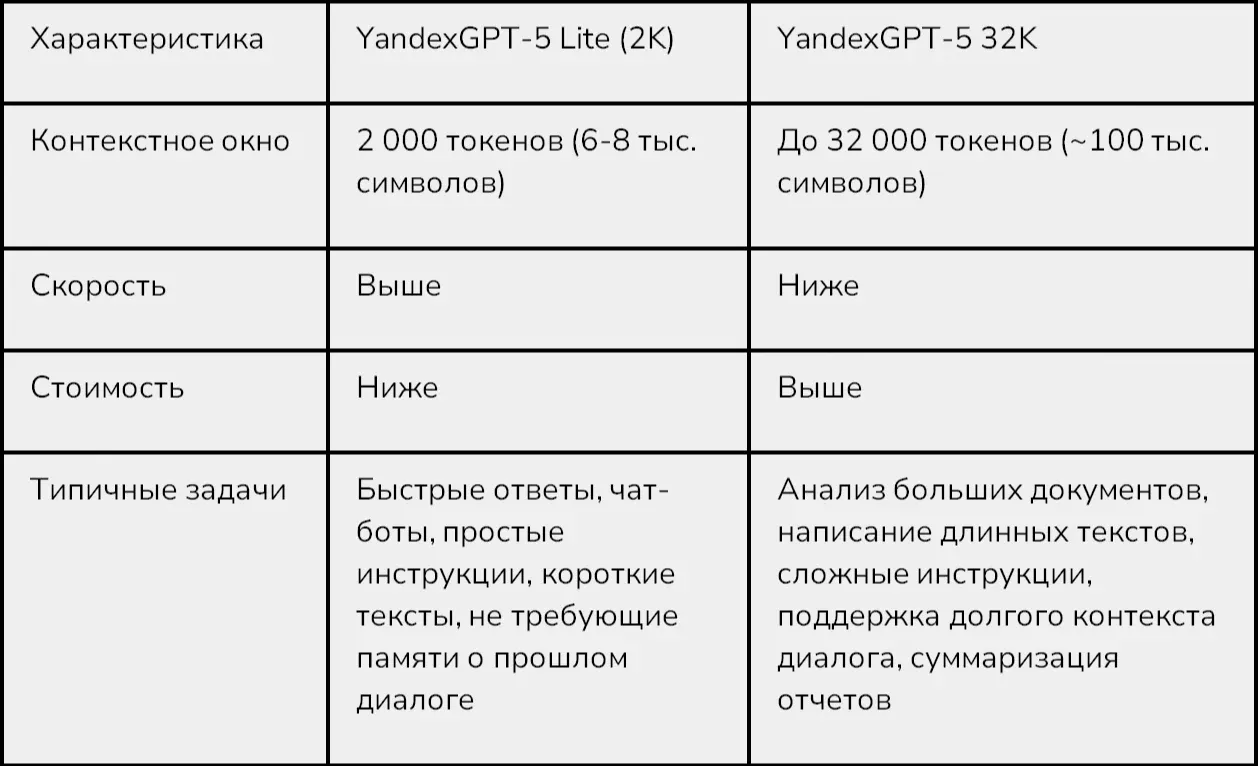
Comparison table for YandexGPT-5 32K and YandexGPT-5 Lite 2K
When to use Lite (2K):
- You need a quick answer to a simple question.
- The task does not require remembering much earlier information.
- Budget and speed are critical.
When to use 32K:
- You need to analyze an article, a report or a legal document.
- You are writing a long text (a book chapter, a detailed guide) and want the model to remember the beginning.
- You are running a complex dialogue where every earlier turn matters.
- You are handing the model bulky instructions or examples (Few-Shot).
Tip: start with Lite (2K) for simple tasks. If you feel the model is running out of "memory" or the task involves processing a large text, switch to 32K.
Tips for consistently strong results
- Iterate: the perfect prompt rarely comes out on the first try. Didn't get what you wanted? Change the prompt a little (add a detail, rephrase the task, refine the format) and try again.
- Experiment: try different wordings of the same task. Sometimes a small change in words produces a completely different result.
- Clear constraints: if the model writes too much, add Limit the answer to X words/sentences. If it drifts off topic, remind it: Focus only on [the specific topic].
- Fact-checking: don't trust the model blindly, especially when dates, figures, names or scientific facts are involved.
Conclusion
YandexGPT-5 is a versatile language model that becomes even more accessible and convenient through its integration with the GPTunneL platform. Its command of Russian, its flexibility across tasks and the availability of a version with a huge context window (32K) make it a useful assistant for a wide range of users.
We hope this guide has given you useful information about the specifics of prompt engineering for YandexGPT-5 and will help you use the model for your own tasks. Success usually comes down to practice and experimenting with how you word your requests.
Start right now! Try YandexGPT-5 in GPTunneL. Good luck!