
OpenAI o3-Mini is a transformer AI model from OpenAI that was recently added to GPTunneL. It is aimed at STEM tasks such as programming, mathematics and scientific research. Designed as the successor to the o1-Mini model, o3-Mini combines high speed, improved accuracy and extended capabilities, including support for function calling and structured outputs..
Advantages of the model
Speed and efficiency:
- According to the data in the o3-Mini announcement on the OpenAI website, the model answers requests roughly 24% faster than its predecessor o1-Mini, which makes it especially attractive for tasks where minimal latency matters. You can compare the models yourself in our Arena.
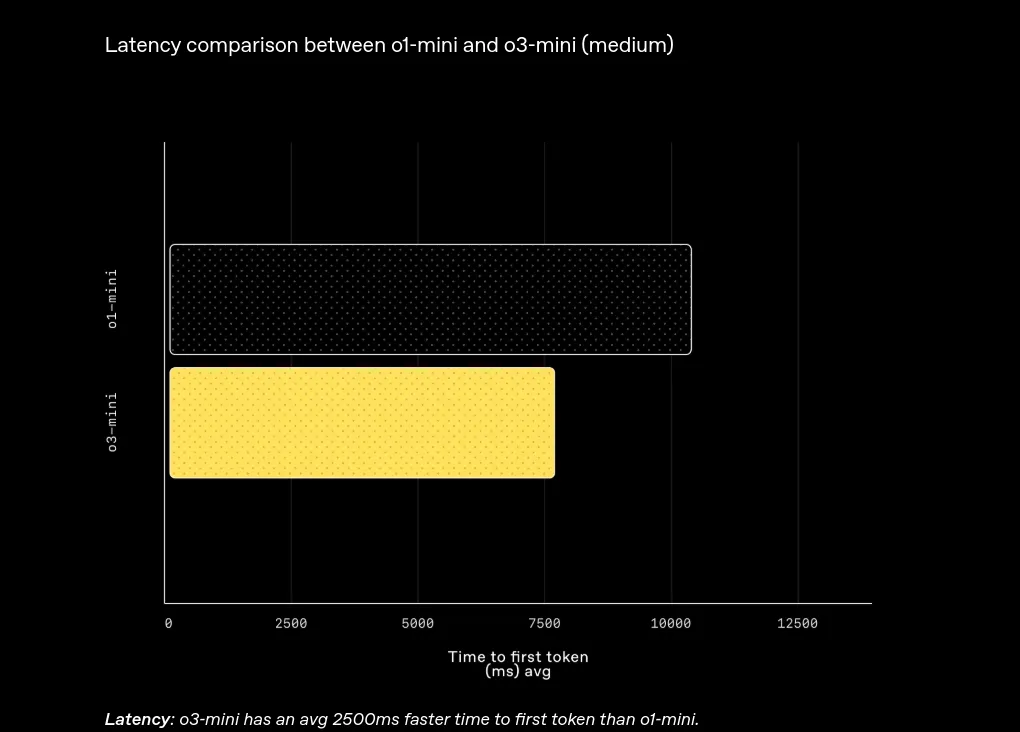
Caption: On average, o3-mini starts generating an answer to your request 2.46 seconds, or 24%, faster than o1 Mini (7.7 sec. versus 10.16 sec.).
Versatility and accuracy:
- The model shows improved results on complex tasks: testers at OpenAI noted that the number of major errors dropped by 39% compared to o1-Mini, and experts prefer o3-Mini answers in more than 56% of cases.
- A dedicated mode for STEM tasks allows the model to solve logical, mathematical and programming questions at a high level. It is worth noting that the model can take in as much context as its predecessors — 128K tokens. In practice this means you can hand it entire books to process.
- The developers paid particular attention to the reasoning process. For example, during generation the model lets the user know which stages it went through and why it produced exactly this answer. This was present in o1-mini, but to a lesser degree.
Benchmark data
- Mathematics
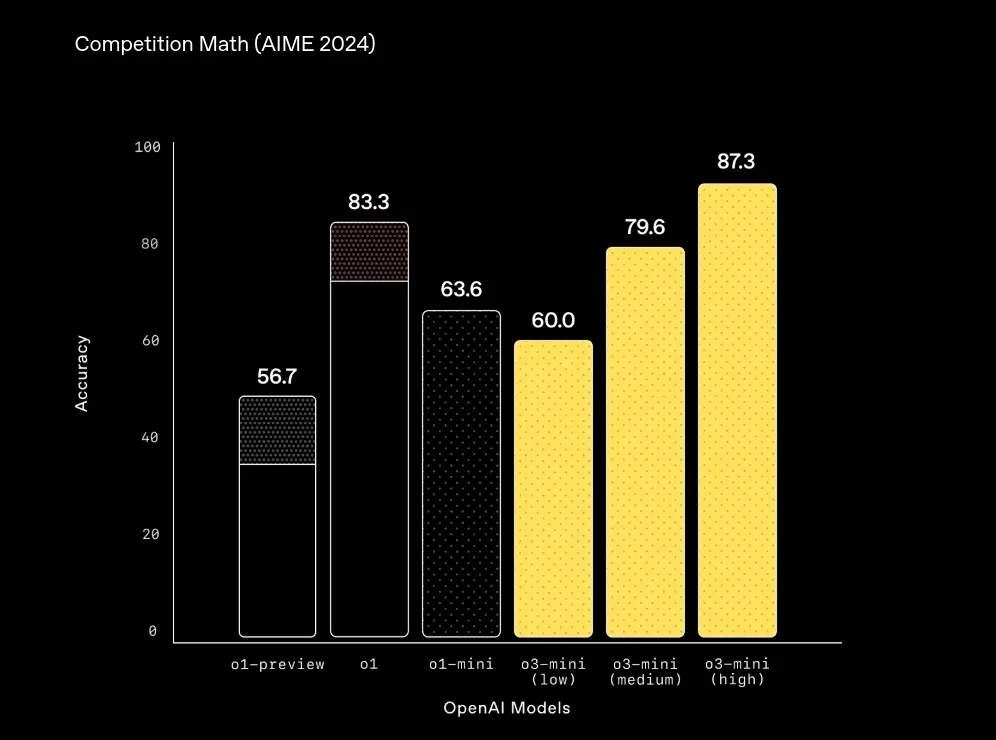
The o3-mini (medium) model available in GPTunneL handles 79.6% of the tasks in the AIME 2024 benchmark, whose goal is to test the capabilities of artificial intelligence on the hardest mathematical problems. The model falls slightly short of the full o1 version, but easily beats its predecessor, o1-mini.
- Science
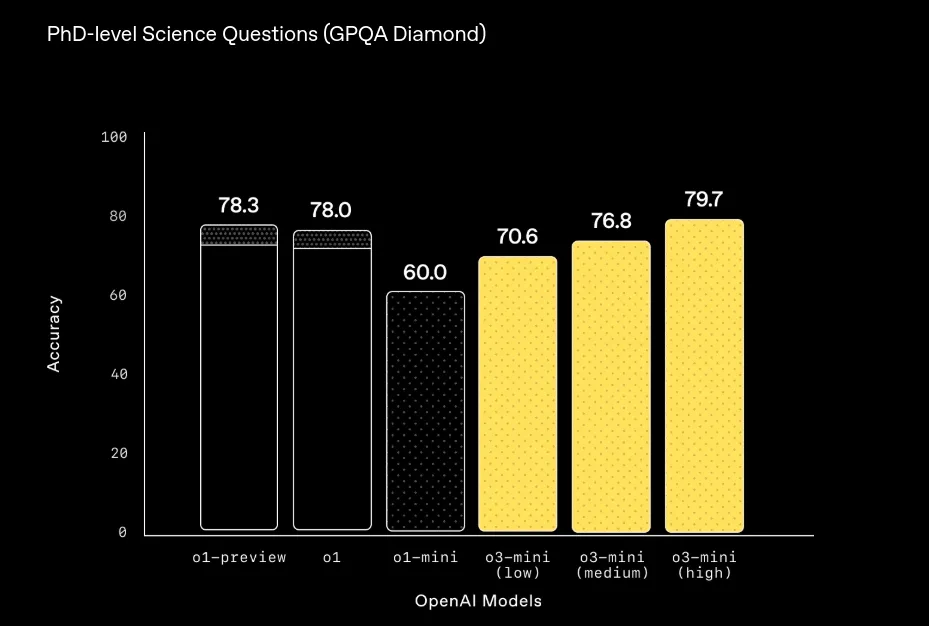
The o3-mini (medium) model also shows excellent results of 76.8% on the GPQA Diamond benchmark, whose goal is to test the abilities of artificial intelligence on academic problems. For comparison, o1-mini scores 60%.
- Codeforces
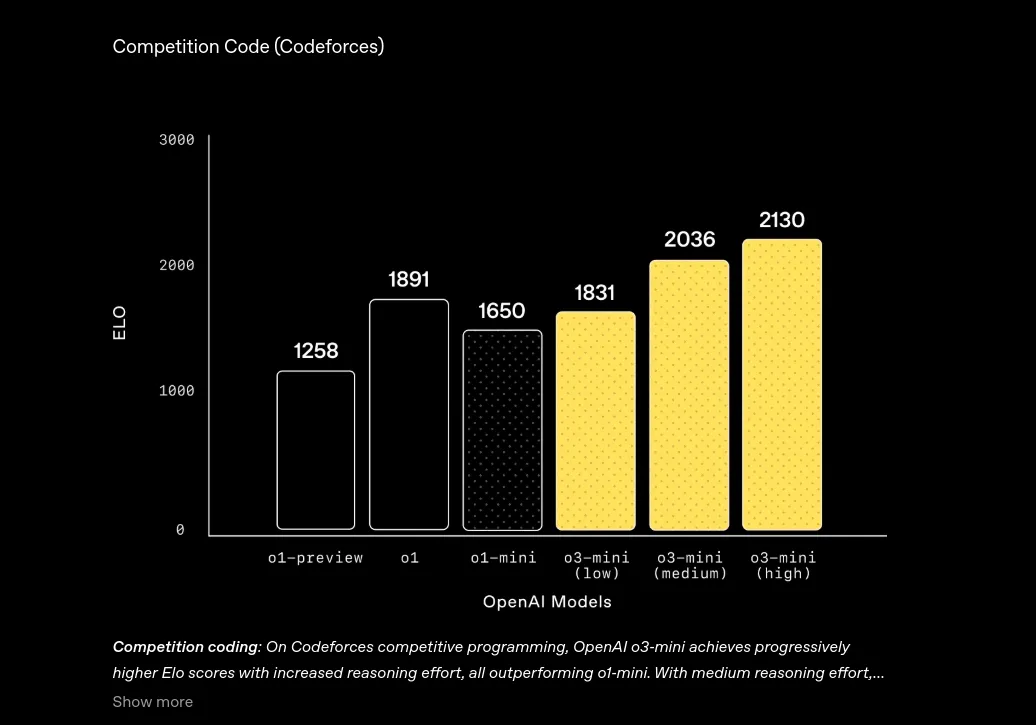
In Codeforces competitions on solving the hardest programming problems, OpenAI o3-mini (medium) shows a high Elo score of 2036 points. For comparison, the average rating of Codeforces participants is around 1500 points, and the highest rating belongs to a user under the nickname tourist, who reached a rating of 3821.
Prompting tips
The o3-Mini model can take in large volumes of context, many facts and parameters, and work with a variety of prompting techniques. Its transformer architecture lets it analyze and process complex, detailed requests, which is one of the key advantages of modern language models. However, brevity and clarity in the wording of your request remain important for several reasons:
- Focus of attention:
Although o3-Mini can take into account extensive context of up to 128K tokens, a concise and clear request helps it identify the core of the task faster. This reduces the risk that the model will spread its attention across less significant details, and lets it focus on solving the main problem.
We recommend changing your requests gradually, guided by how the model carries out its reasoning process.
- Fewer ambiguities:
Long requests overloaded with details can create ambiguities that make the task harder to interpret. A structured request minimizes such risks and helps you get a more accurate and relevant answer. We recommend communicating with o3-mini like with any human assistant — gradually clarify the details, write clear instructions and share your observations on the topic of the conversation.
- Faster processing:
A clearly worded request lets the model "understand" faster what is required of it, which shortens the time it takes to generate an answer. This is especially important in scenarios where response speed is critical.
- Flexibility in using prompting techniques:
o3-Mini handles various approaches well — whether it is role prompting, zero-shot, few-shot or even complex, multi-step instructions. At the same time, even though the model can analyze long texts, optimizing your request through brevity and clarity helps ensure a structured and focused result. Read in the prompting techniques section about prompting methods.
Despite the impressive ability of o3-Mini to work with complex requests, brevity and clarity remain important tools for increasing the efficiency and accuracy of its work. This does not limit the model — on the contrary, it lets the model use its full potential, interpreting requests quickly and correctly even when they contain many parameters and details.
After all, why build a model that cannot process complex requests if that very ability is its key advantage? Effective interaction with the model is achieved exactly when even complex ideas are formulated briefly and clearly. Below we offer advanced prompt examples for o3-mini.
Prompt examples
Programming
1. An array sorting function using quicksort
Write a Python function that sorts an array of integers using the quicksort algorithm. The function must handle arrays with duplicate elements correctly and return the sorted array. The implementation must not exceed 50 lines of code. In comments inside the code, briefly describe the key stages of the algorithm (for example, choosing the pivot, partitioning the array, recursively sorting the subarrays).
Comment:
The prompt sets specific requirements: a Python function, a 50-line limit, correct handling of duplicates and explanatory comments. This helps you get a compact and understandable solution.
2. Optimizing a code fragment
Take the following Python code fragment and optimize it to reduce the number of computational operations while preserving the original functionality. Explain the changes you made and their impact on performance. Try, if possible, to reduce the execution time by using more efficient algorithmic solutions or built-in Python functions, and add comments explaining every stage of the optimization.
Comment:
The prompt requires optimizing the code while preserving functionality, explaining the changes and their impact on performance. Clear instructions contribute to a structured and effective answer.
Mathematics/Physics
1. Calculating the limit of a sequence
"Determine the limit of the sequence given by an expression where the numerator is the n-th root of the factorial of n, and the denominator is the number n divided by the exponential (e). Use Stirling's approximation for the factorial. Describe step by step how the approximation is applied and why it is justified, and explain what value the sequence tends to as n tends to infinity."
Comment:
The request is complex because it requires applying an asymptotic approximation and explaining every stage of computing the limit in detail, but it is stated clearly enough for the model to focus on the key steps.
2. Computing the Gaussian integral by moving to a double integral
"Prove that the integral of the function exp(-x²) with respect to x from zero to infinity equals half the square root of pi. Use the method of moving to a double integral and the corresponding change of variables. Describe all the transformations step by step and explain why this approach yields an exact result."
Comment:
Although the Gaussian integral is a classic problem, the request is made harder by requiring a detailed description of the move to a two-dimensional integral and the change of variables, which demands deep analysis and clear structuring of the answer from the model.
3. Solving a system of differential equations by the eigenvalue method
"Consider the system of linear differential equations: dx/dt = 3x + 4y and dy/dt = -4x + 3y. Find the general solution of the system using the method of eigenvalues and eigenvectors. Describe in detail the process of forming the characteristic equation, finding the eigenvalues, computing the corresponding eigenvectors and formulating the general solution, explaining how each part of the method contributes to solving the system."
Comment:
This request requires a comprehensive approach that includes linear algebra and differential equations, while being stated in enough detail for the model to give a structured, step-by-step answer.
Scientific research or data analysis
1. Analyzing population growth statistics
Analyze the provided data on population growth in major cities over the past five years. Identify the main trends, seasonal or structural changes and possible factors influencing the growth dynamics. Based on the analysis, produce a well-grounded forecast for the next year using time series methods or regression analysis, and present the results in a structured form (for example, as a table or a chart). Explain why the chosen analysis method suits this data and what limitations may affect the accuracy of the forecast.
Comment:
The prompt clearly defines the stages of the analysis — identifying trends, applying time series/regression and structuring the result — which helps the model focus on the key elements and justify the chosen method, taking the limitations of the data into account.
2. Writing an introduction for a scientific paper
Write an introduction for a scientific paper devoted to recent achievements in the field of artificial intelligence over the past two years. The introduction must:
- Describe the dynamics of AI technology development over this period;
- Highlight the key trends and innovations, such as the appearance of new models (for example, DeepSeek R1, o3-Mini and others);
- Point out the practical application of these achievements in different fields (programming, medicine, science and so on);
- Identify the main challenges and problems the industry faces and the ways to solve them;
- Finish the text with an overview of the paper's structure, outlining the main sections.
Aim for a text that is logical, structured and encourages the reader to explore the rest of the paper.
Comment:
The prompt defines the structure of the introduction: AI dynamics, key trends, practical application, challenges and an overview of the sections. This helps the model create a logical, structured and motivating text that captures the reader's attention.
Conclusion
OpenAI o3-Mini is a significant step forward in the development of AI models. Thanks to improved speed, higher accuracy and new features, it is becoming an indispensable tool for solving a wide range of tasks, especially in the STEM field.